

Analyzing the Black Box: A Blueprint for Human-in-the-Loop Architecture

Looking at the state of the world recently, it’s become a regular occurrence for companies, large and small, to go 'all-in' on an AI-embedded future. This article (and this one as well) further demonstrate a shift where human capital is increasingly viewed as a secondary asset for productivity, while AI becomes the primary driver.
The articles above should paint that picture for you clearly. CEOs are now explicitly calling out AI as the catalyst behind mass layoffs, basically configuring human talent to nothing more than a cost centre.
I do believe the long-term outlook is one where AI, along with a sophisticated stack of autonomous agents, will have ownership of the majority of tasks that drive organizational value. But the near future, the one that’s well underway, looks a little different. A future I feel is where the winners of this decade will be decided.
The truth is that the most successful organizations won’t be the ones that automate everything, they’ll be the ones that mastered the strategic lens for their company. The ones building the systems where AI handles the heavy lifting (such as processing and validation), while humans remain “In-the-Loop” to provide the one thing a large language model cannot at this point: contextual judgment.
This is the blueprint for the Human-in-the-Loop (HITL) architecture.
The Fallacy of the Black Box
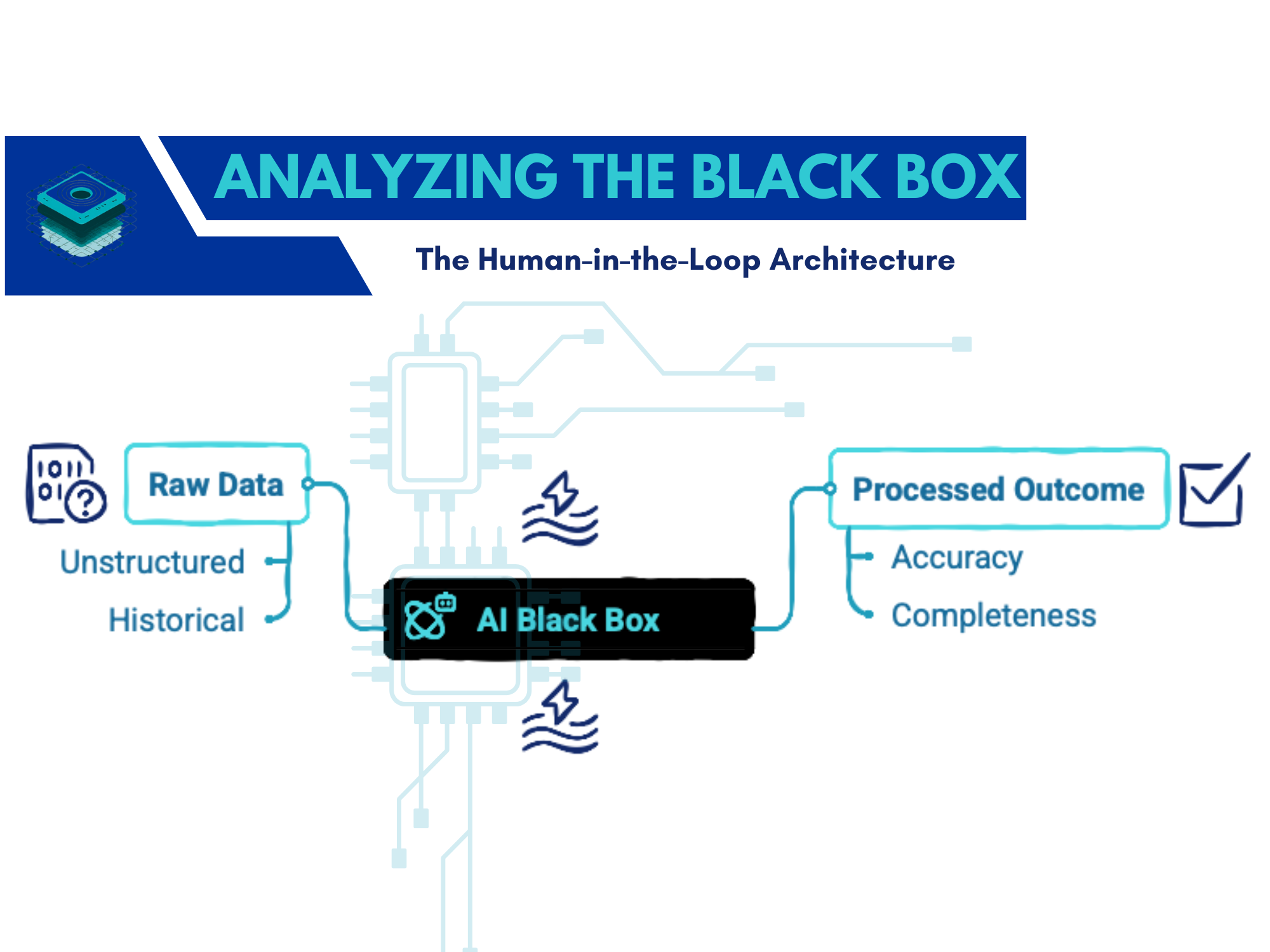
In software engineering, a “Black Box” is a system where you can see the inputs and outputs, but the logic in between is opaque. Many leaders pushing AI initiatives are building black box operations. Feeding raw data into an AI agent and waiting for a project plan to spit out the other side.
This works ok for systems that are closed. Operations, on the other hand, are open systems.
Operations for most companies exist in a messy world, where complexities show themselves through human politics, shifting client moods and cultural dynamics. There rarely is a straight line from A to B, regardless of how bullet proof their processes are. For ops leaders going all in on AI and removing the human from the loop, end up removing the only sensor capable of detecting these nuances.
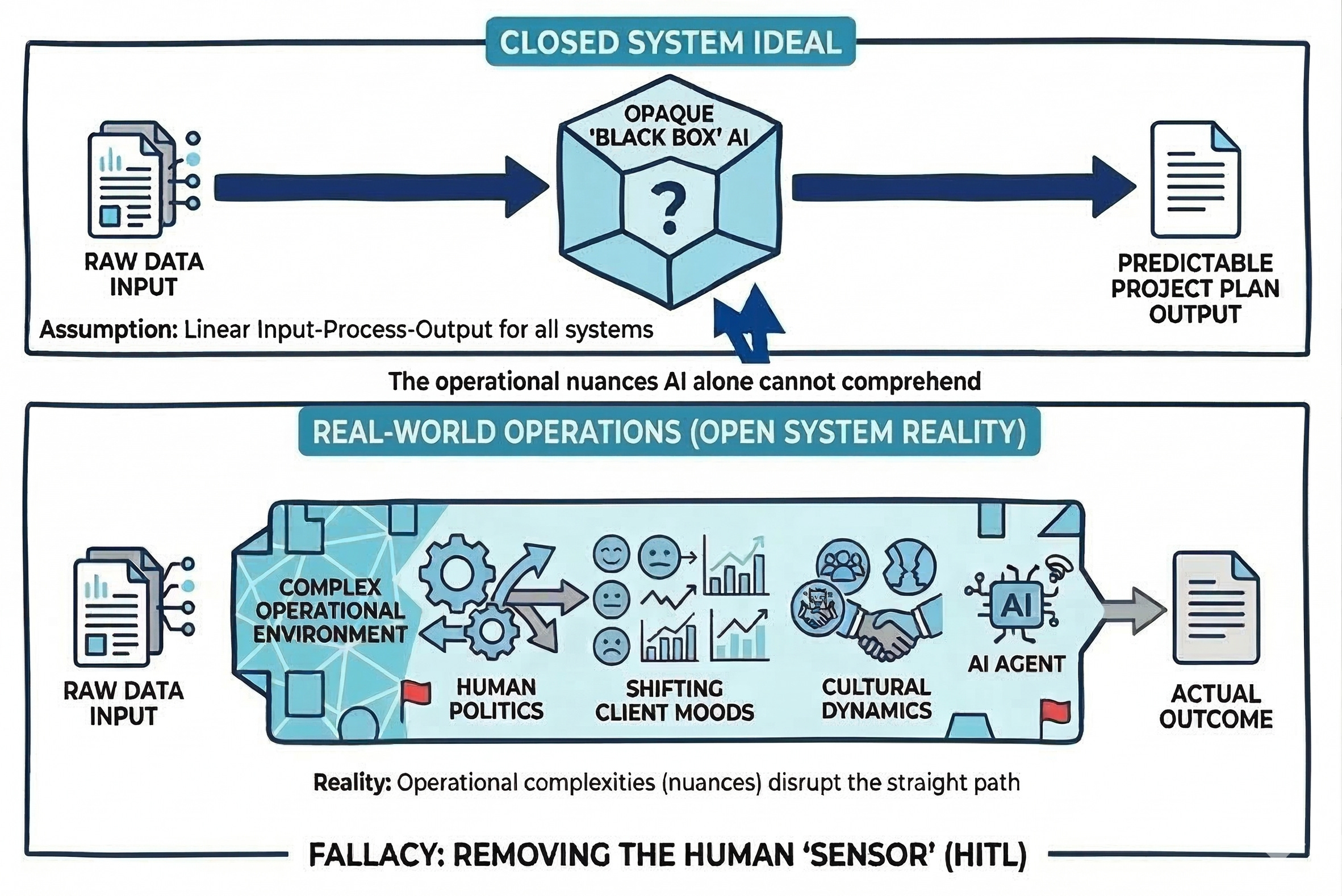
An AI agent can do a wide range of things, such as tell you that a project is 10% over budget or your process didn’t meet the necessary steps of compliance. It cannot however, output the juicy insights that matter, such as the client’s CEO is currently under pressure from their board and that a 5% budget overage (while technically small) will trigger a political firefighting situation that could be an account killer. These are things only humans can bring to the table.
When we automate without a strategic lens, the friction we think we’re eliminating just gets pushed downstream. We pay the trust tax later because our systems were too fast for our own good.
So how do you take that extra step and do a full on investigation on your black box? You need to become exceptional at strategy identification.
The Masters of Strategy
The very best operators do two things better than the competition:
They possess an absolute grasp of their strategy, business model, and company ethos.
They have the capability to infuse this knowledge into every fiber of the organization.
When these two pillars are in place and actively nurtured, an organization moves at light speed. Decisions are made faster, and every tactical step is aligned with the ultimate objective.
My prediction: for the foreseeable future, this will remain a human-centric asset. The faster an operator can master and own the strategy, the sooner they can unleash truly impactful AI. This creates a system where AI agents work in tandem with humans to offer the perfect mix of automation, quality, and context needed to leave outdated ways of working behind.
To build that system, we next need to learn the fundamental unit of velocity: the decision.
The Decision Quality Formula
To understand why HITL is mandatory for velocity, we have to look at how decisions are actually made. As a strategic operator, you should view every decision as a calculation of data and context.
Where
Q = Quality of the Decision
D = Raw Data
A = AI Processing Power.
C = Context (Politics, Culture, Timing).
H = Human Lens (Judgment/Empathy).
In this model, AI is a force multiplier for data. It can process raw data at a scale no human can match. However, if the human lens is zero, the second half of the equation vanishes. You are left with a decision based purely on a static process. Specifically, you’re left at the mercy of a process created in the past, devoid of the context required to make the right decision for the specific moment.
Additionally, the Human lens is ultra valuable as a “stop the line” level of QA in the (hopefully) rare instances the AI agent catches an anomaly of some sort. A human can do a decent job vetting if hallucinations are present, or if the current company/industry landscape is present in the latest rounds of output from the process.
Implementing HITL in Your World
Whether you are knee-deep in AI agent implementation or hesitant to even start for the smallest of processes, taking a step back and looking at your organization holistically with both AI agents and humans in mind should be your next step.
Let’s begin by addressing the foundation: Strategic Mastery. Nothing (and I mean absolutely nothing) of value happens without context. It starts with you, the leader, having a firm grasp of the strategy. It ends with ensuring your team lives and breathes the "Why" behind every move and goals are aligned from the ground up. If the strategy isn't ingrained in the people running the system, your AI agents won’t accomplish much outside of automating low value things.
Once that context is locked in, it’s important to emphasize that transitioning from a “Black Box” operation to a Human-in-the-Loop architecture doesn’t mean rebuilding your entire company or department overnight. You simply need to re-engineer the “seams”, those specific points where information transitions from one state, or one team, to another.
It doesn’t really matter what you’re managing. Overseeing a software development sprint, a global supply chain, or a sales-to-service handover, the minimal implementation of the HITL follows these non-negotiable gates:
Gate 1: Define the Intent Anchor (The MVC)
Automation fails when the “Why” is assumed rather than articulated. In your world, this means every major task or handover must start with a document that provides needed context. What I call the Minimum Viable Context (MVC). The MVC contains all the messy nuances that show how your process really works and how it changes based on various inputs. Ideally, this is done when processes are still fully operated by humans. If you want a refresher, I go into the MVC in greater detail in my previous article.
When you’re ready for AI agent involvement, a human must first double check how this initiative ties to the greater strategy. You want to have AI to generate velocity and the highest value processes first. Attempt to answer such as questions as “What is the specific business driver? What are the political landmines? What does a ‘win’ look like for the end-user?
Architect's Tip: If you can’t summarize the strategic intent in three sentences, you aren’t ready to automate. The machine will only amplify your ambiguity.Finally, spend some time identifying which phases of the workflow are primed for AI automation versus those where human intuition remains the key driver. Look where the pain is. Whatever causes the biggest time suck or human error, should be the biggest red light for you.
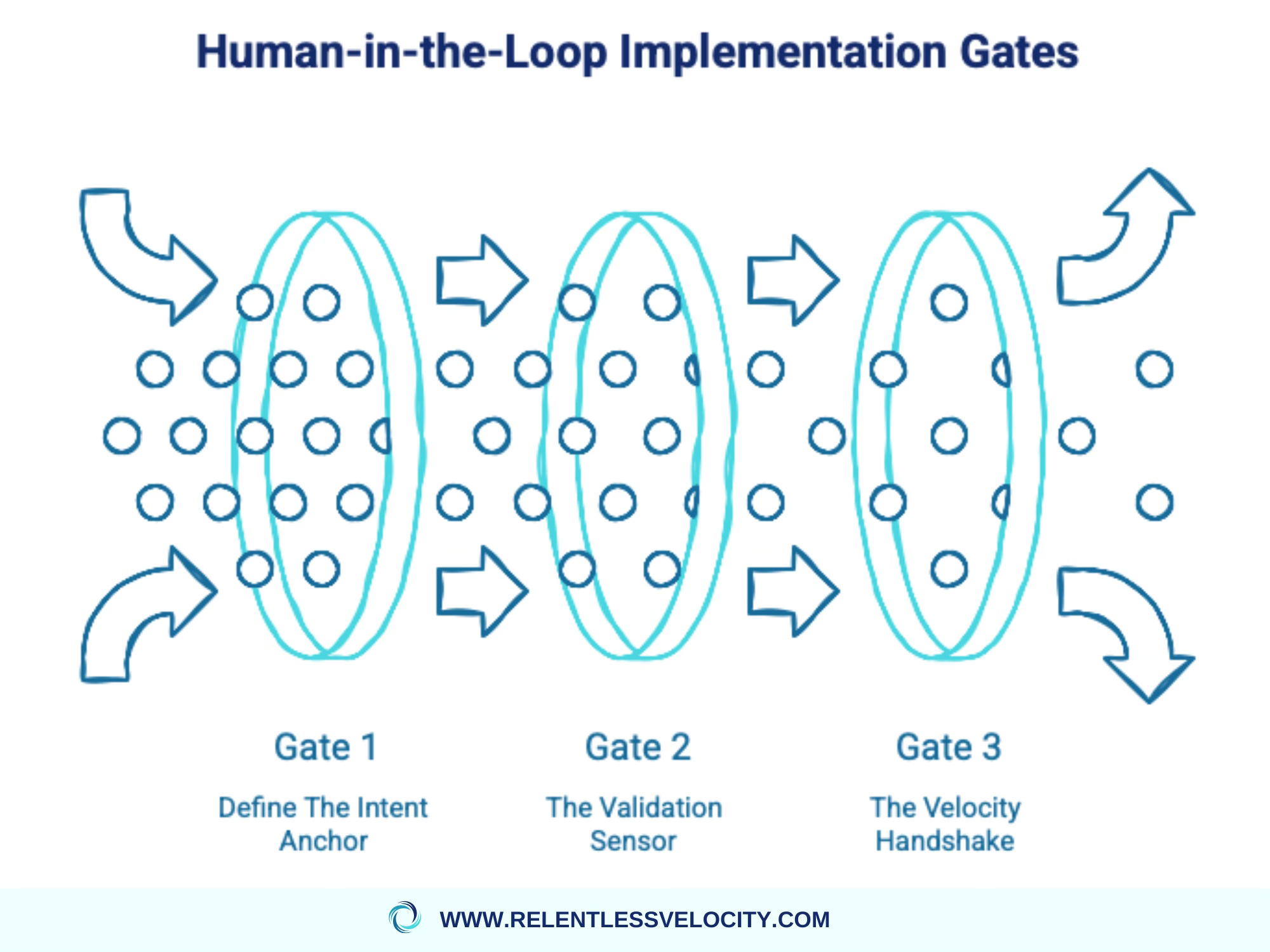
Gate 2: The Validation Sensor (The Logic Check)
This gate takes place after your initial build is in place and AI is doing the “heavy lifting.” Let the agents audit the data, check the budget spreadsheets, and verify that all the required fields are filled. Somewhere prior to the finished output, you must install a validation sensor.
This is a “fail-safe” trigger where the AI is instructed to stop and alert a human if the data is complete but the logic is inconsistent. For example: if the AI detects a project timeline that hits 100% capacity but fails to account for a major holiday or a known client blackout period, the human equipped with the necessary context must intervene.
What’s critical here is to feed the results, regardless if it’s a standard hallucination by the AI or a true anomaly that was captured back into the system. Recursive self improvement gets an additional boost when I human continuously feeds updated data into the machine.
Gate 3: The Velocity Handshake (Trust)
The final stage of implementation is the most human. Once the AI has processed the data and validated the schema, the final handover must be between humans.
The HITL architecture provides the new owner (the next process) with a “Velocity Brief”, an AI-distilled summary of exactly what they need to know. I love this as it eliminates a meeting that can delay things to simply 10 minutes of confirmation. The human lead uses the brief to confirm: “I understand the North Star, I see the risks the AI identified, and I am taking ownership of the execution going forward.”
Simply beginning with gate one, verifying it works as expected and moving to the next gate is an acceptable approach to rolling this out. Each gate provides compounding value as it passes through this unified architecture, but remember: the gates are only as strong as the context you’ve already ingrained in your team.
As friction begins to leave the system, execution becomes significantly less labor-intensive. This is where we really see the future become the present: manual roles transform into architectural ones.
The Architect’s Role in 2026: From Operator to Governor
The fear that AI will replace the Project Manager or the Ops Director is based on an old definition of those roles. If your value was chasing people for updates or being the communication source between teams, then yes, you’re in a pretty bad spot.
But if the value you bring transitions into architecture, your importance has never been higher.
As a Strategic Architect, you’re no longer the one doing the work. You’re the one designing the loop. You’re the one who decides where the AI is allowed to run unencumbered and where the system must slow down to allow for a human lens.
Becoming the role that enables HITL architecture requires a significant shift in your daily skillset. It’s an investment of effort up front that produces exponential dividends in velocity. Here is how you lead that transition:
1. Audit the Black Boxes
The Skill: Logic Mapping. If AI is already present in your function, you must identify where it is making decisions in a vacuum. A “Black Box” is any point where data goes in and a decision comes out without a verifiable trail of why.
The Action: Map your current automated (or soon to be automated) workflows. At each step, ask: “If this AI makes a wrong turn, how long would it take us to notice?” If the answer is at the end of the project, you have a black box situation. You must engineer a logic gate where the AI’s reasoning is surfaced for human audit.
2. Define the Seams
The Skill: Information Architecture. Context is most likely to leak at the hand-off points between teams or agents. Traditional roles see this as a problem to be solved with face-to-face interaction. Architects view this as a system of APIs. This means logic is engrained in the process upfront with simple pass/fail mechanisms. It either passes the baton or it doesn’t.
The Action: Audit every hand-off. Instead of a Slack thread that has no long-tern structure and traceability, define a rigid MVC (Minimum Viable Context) schema for that seam. You must have the skill to say: “The handover is not complete until these five specific strategic anchors are documented.” This is you being the architect and designing the protocol for it. Learn to codify the MVC so you can pass this off to AI to vetting 99% of this sequence in the future.
3. Appoint the Loop Owners
The Skill: Strategic Alignment. An agentic system without a “Why” is directionless at best. You must appoint “Loop Owners”, I nifty term for humans responsible for providing the strategic intent to the agents at critical steps.
The Action: Train your team to move from being the ones doing the work to being editors. Key skills to learn and build off of are prompt engineering and contextual validation, ensuring the “Why” is never lost in the “How.”
4. Calibrate Decision Latency
The Skill: System Optimization. This is the most critical skill of the architect, ensuring speed maintains a high level of standard as complexity and processing volumes rise.
The Action: Learn to build latency heat maps. If human involvement is too high at a low-risk seam, velocity will drop. If it’s too light at a high-risk seam, invisible tax will rise. What you’re looking for is the Goldilocks Zone. The perfect calibration where the system moves as fast as possible without losing its strategic integrity.
I could write a deep-dive on every one of these pillars, so I know this isn't a 24 hour transformation. As with any complex system, continuous, iterative progress is the only way forward. Master the first step, then pivot to the next. In time, you’ll possess the architectural lens that is quickly becoming the most coveted skill set in the future of work.
Conclusion: The New Competitive Edge
The world is moving at a pace where predicting anything is impossible, and no one can guarantee exactly what tomorrow’s stack will look like. But I’m certain of this: the tug of war between fully autonomous AI and traditional manual ops won’t have a single winner.
The highest-performing organizations of this decade will build a bridge between the two.
The Human-in-the-Loop architecture is where the world’s most resilient companies will anchor their operations. It’s the only way to move at the speed of light without losing your strategic soul.
Time to buckle up!