

The Invisible Tax: Why Bad Handovers are Killing Your Velocity (and How to Kill Them First)

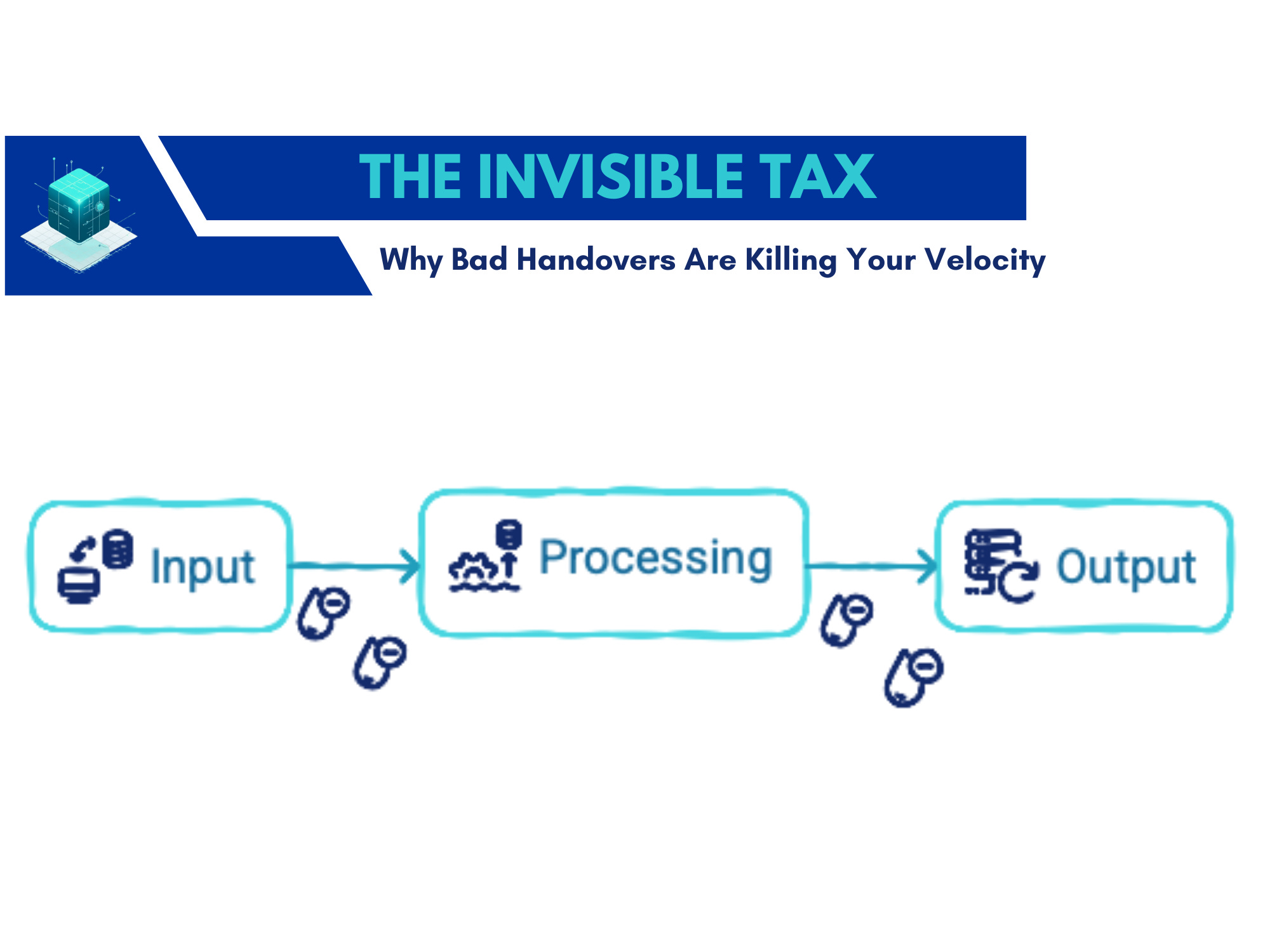
In my experience scaling operations for companies, I’ve observed a consistent opportunity cost that (more often than not) creates a staggering profit gap between high-velocity teams and the sleepy giants.
The most insidious of these costs and most difficult to catch are systemic, built into the very DNA of operations. They often live at the seams, the hand-off points where one process meets the next. They attack your most expensive resource: Momentum.
I refer to this as the Invisible Tax of Bad Handovers.
I’m sure you’ve seen this play out in your line of work. Take Sales, for example: Business Development spends three months winning a key client, promising a seamless implementation. Once the deal is closed, they toss a “contract signed” notification over to the project manager and implementation teams. It’s the end of one process where they next one begins.
This is the exact moment the tax is collected.
Here is what usually happens at this point. Over the next week, the implementation teams starts by digging through messy CRM notes. Between back-and-forth Slack messages and a series of internal catch-up meetings, hours are burned just to figure out what was promised regarding timing, scope, and delivery.
Ok great, there’s now some alignment internally. Unfortunately the problems have only begun. Next comes the kickoff with the client, who is forced to repeat the same discovery and brainstorming sessions they just finished with the Sales team. Keep in mind: we haven’t even started the actual work yet.
As you can imagine, this isn’t just a Sales-to-Implementation problem. It happens every time two processes collide and two or more teams are involved in a handover.
In this all-too-common loop, velocity drops to zero, trust evaporates, and morale sinks. While I call it the “Invisible Tax,” it’s actually a bundle of three distinct cost centres:
1. Quantifying the Tax: The Three Cost Centres
When information is lost during the baton pass, you end up paying in three specific ways:
The Re-Work Tax: This is the cost of re-learning what was already known. If a lead spends five hours auditing a discovery call because the notes were incomplete, then you’ve just lost five hours that should have been spent on strategic execution.
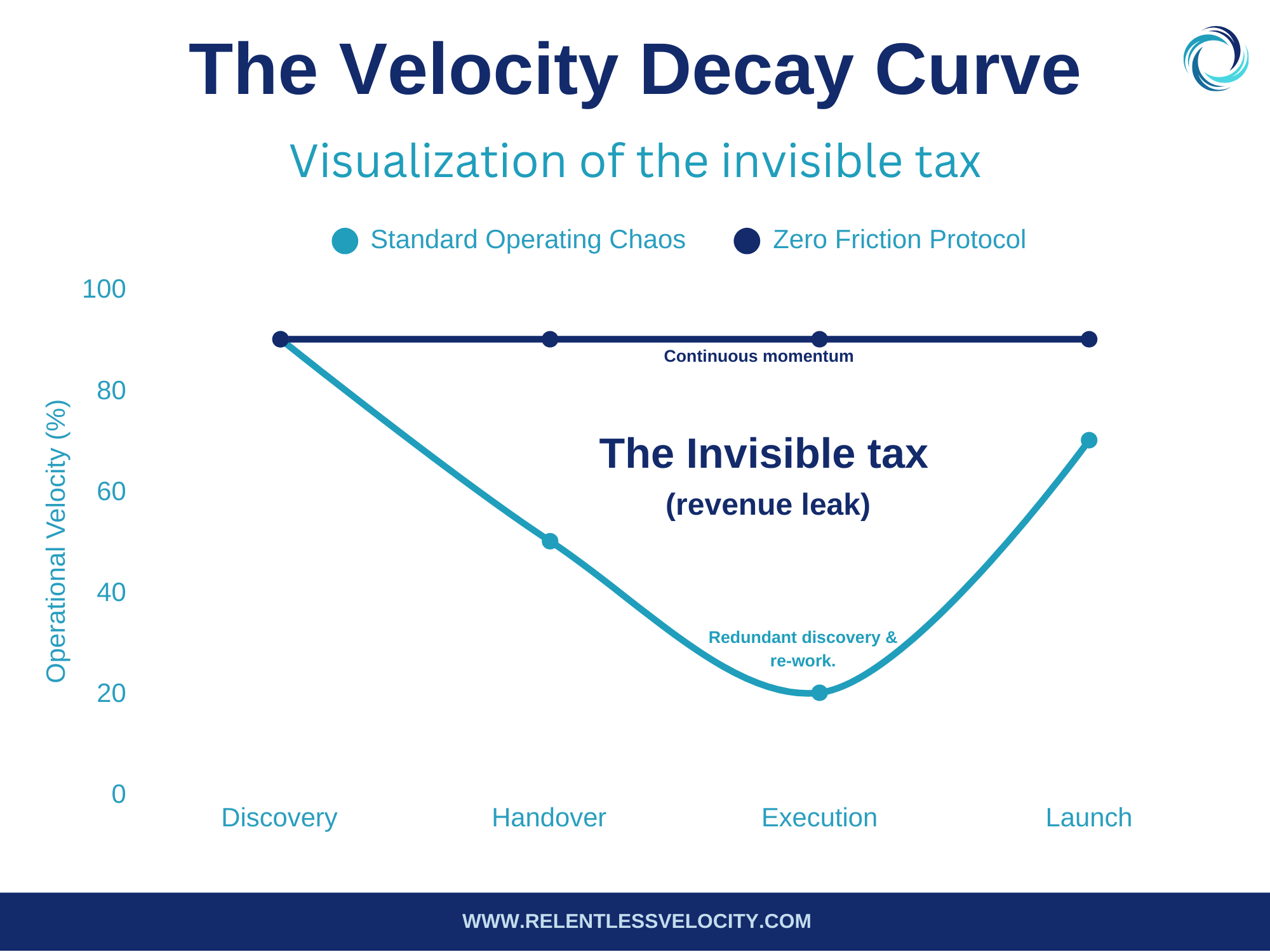
The Momentum Tax: Projects are like physical objects: it takes more energy to start them than to keep them moving. A bad handover creates a dead zone (roughly 48-to-72-hours) where a project sits idle while the new owner gets up to speed. In a multi-project organization, these windows stack up to a multi-story building of lost time every year.
The Trust Tax: This is the most expensive one. The moment a stakeholder realizes your The vision presented is out of step with Execution, they stop seeing you as a partner and start seeing you as a vendor. You are now under a microscope with a shrinking margin of error.
Fortunately, eliminating this tax is a straightforward engineering problem. It requires a more rigorous standard between the outgoing owner and the incoming lead. The key is a mindset shift I’ve adopted: treating documentation like code.
2. The Strategic Lens: Documentation as Code
In software engineering, an API (Application Programming Interface) allows two different systems to talk to each other through a rigid, predictable set of rules. If the data sent to the API is messy or missing a field, the request is rejected. Simple as that.
Your handovers should function the same way. We need to treat any documentation that runs through these systems as code. To state this as clearly as possible, your handover documentation must be:
Standardized: No free-form emails. Use rigid templates where every field is mandatory.
Version Controlled: You must be able to see when the scope changed and why.
Executable: The documentation should trigger the next action (i.e. an automated Slack alert or a Jira board creation), essentially eliminating anything sitting in a “General” folder.
As a leader, ensuring the downstream impact of your work is frictionless should be viewed as a requirement for execution. By applying a system-first mindset to these “seams,” you set the next team up for success and maintain the organization’s overall velocity.
To make this practical, let’s look at the specific framework I’ve used in the past to enforce these rules.
3. The Framework: The Zero-Friction Protocol
Over the years, I’ve battle-tested various frameworks to shore up the handover process. And while no single method fits every scenario, there is a universal middle ground that can be reached. What I’ve found works best, regardless of industry, company size, or specific process, is a three-gate system I call the Zero-Friction Protocol. This framework ensures that velocity remains constant as a project transitions from "Vision" into "Execution”.
Let’s look at each further.
Gate 1: Minimum Viable Context (MVC)
Before an initiative is allowed to exit its current phase, it must meet the MVC standard. Think of this as the schema validation for your handover.
As the process owner, you are responsible for certifying this information before the “beneficiary” (the next team) is even notified. This is internal Quality Assurance at the process layer. If you are building your MVC from scratch, these five questions apply to almost any transition:
The “Why”: What is the high-level strategic objective this work serves? (The Anchor).
The North Star: What is the specific, measurable outcome that defines a “win” for this transition? (The Target).
The Won’t Do: What is explicitly not being done? This is your primary defence against scope creep. (The Boundary).
The Documentation: Does the team taking the baton have the executable playbooks and context needed to run? (The Engine).
The Landmines: What are the known technical, political, or cultural risks that could stall progress? (The Radar).
Gate 2: The Downstream “Fail-Safe”
In this gate, the receiving team reviews the MVC before the work is officially accepted into the new phase. If you identify the receiver of the process as the client then you can think of this as the UAT for Information.
If the documentation is missing a “North Star” or the “Why,” the handover fails the Build. Just like a software deployment with a critical bug, it is automatically rolled back to the previous owner. You do not move forward, and you do not assign resources, until the data is clean.
Gate 3: The Velocity Handshake
The final gate is about confirmation over interrogation. The first meeting or interaction after the handover shouldn’t be spent asking “What are we doing?” It should be spent confirming “These are the next steps forward.”
Using the MVC, the new owner should be able to articulate their understanding of the strategy, scope and key constraints in short order with verification from the previous owner. This creates an immediate “Handshake” of alignment. It moves the team to an offensive posture (executing on what’s next).
Conclusion
Your job as a leader is to engineer friction out of the system. Careless process optimization is just another form of opportunity cost.
Take a look at your last three project handovers. How much “Invisible Tax” did you pay? If you’re ready to stop paying the tax and start scaling with precision, you need a system.
Join 580+ Ops leaders and PM Architects below to get articles like this sent straight to your inbox.