

The 2026–2030 Role Diagnostic: Are you an Operator or an Architect?
(#001: Personal Infrastructure)

I’m currently deep in the lab researching, testing, and drafting a complete curriculum on the future of work for traditional operations. This article is one part of a larger series I’ll be rolling out through the rest of 2026. If this perspective resonates with you or adds value to your toolkit, I’d be honoured if you shared it to help get the word out. Thanks for being part of the build.
The launch of ChatGPT 3.5 in late 2022 kick-started a wave of AI activity across the globe. Excitement and anxiety ramped up and haven’t really slowed down since. Every new breakthrough pushed us just a bit closer to a reality only dreamed about by the most future-looking thinkers or sci-fi authors.
Fast forward to today and the last few years of debating the tangible disruption AI can cause isn’t theoretical anymore. It has become the default operating environment for fast-moving companies. The probability is high that the rest of the world will follow suit in short order.
A key catalyst that’s really disrupting the world is the move from AI being a chatbot to something much more valuable: agentic operations. Right now, as you read this, there are autonomous agents executing procurement cycles, forecasting resources across global project portfolios, and drafting technical specifications that used to take teams of senior analysts weeks to finalize. The speed of information has reached a point where the question “Do I really need a human performing this task” should be asked to raise the probability for long term survival.
The scary thing is, with AI progression and adoption moving at galactic speeds, the small minority of us looking to adapt are having a difficult time keeping up. What’s worse, the majority of professionals are still running a 2019 playbook in a 2026 world. They’ve limited their personal adoption of AI to its most basic levels (automated note-taking, draft assistance, and basic research). They’re trying to integrate a once-in-a-lifetime technology that will completely overhaul most roles into a workflow that will likely die away into irrelevancy sooner than they think. The skills that keep the paychecks rolling in for these people are already being done better by a non-human.
The bet I’m placing on myself, and the teams I work with, is what I’m about to share with you. Regardless of the role you play in the operations stack, we must begin working in a way that sets us up for the next five years. We need to immerse ourselves in a new way of systems thinking.
If you’re fearful that the value you bring to work is no longer a reality, it’s not because you lack talent or work ethic. It’s because you’re stuck in the role of the Operator when the world is screaming for an Architect.
This is your diagnostic. It’s time to decide which side of the logic gate you’re on.
The Death of Human Middleware
To understand why the Operator function is facing an existential crisis, we have to revisit the playbook that defined traditional project and Ops roles for the last thirty years, A period where office work and technology became synonymous.
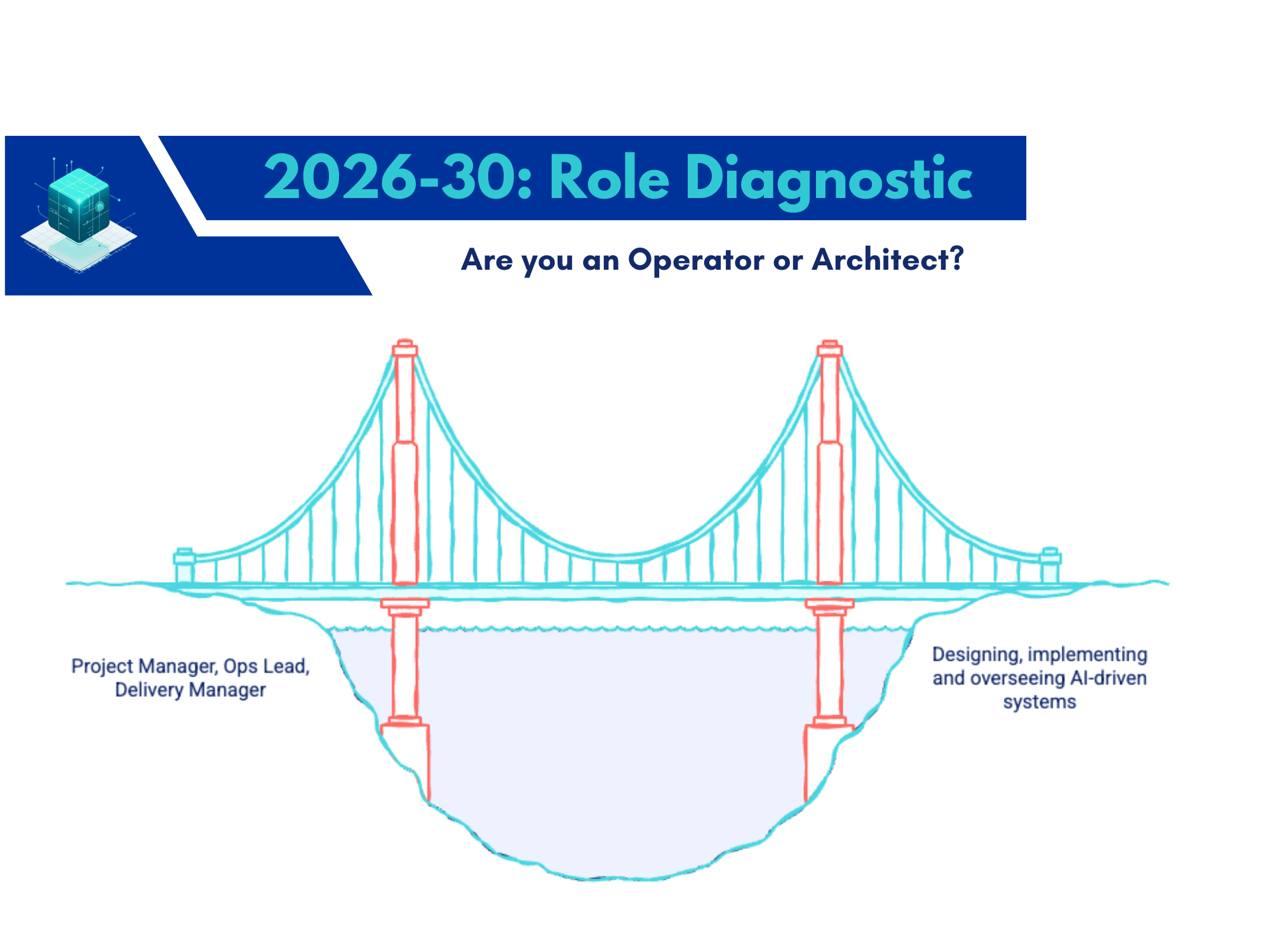
As organizations shifted to being project-based, initiatives exploded in complexity year over year. With an ever-growing data set, roles popped up specifically to sort, analyze, and distribute this goldmine of proprietary knowledge. Value was found in the gaps, where knowledge from one team was consumed, executed on, and then manually shuttled down the value chain. Organizations were messy, data was siloed, and teams didn’t talk to each other. The Project Manager or Ops Lead was the human bridge that spanned these siloes.
I call this Human Middleware.
In a pre-Agentic AI world, being the bridge was where the money was. Having subject matter expertise on the execution layer, coupled with a solid set of communication skills, data tracking, and document creation, were the high-value components of the job description.
But in 2026, those same skills are starting to look like a needless bottleneck compared to their glory days. What was once essential is now a static piece of hardware (meaning us) that information is forced to crawl across at the speed of a human conversation.
Let’s accept the fact that the pace of work will leave us behind if we let it. If information has to wait for you to hop on a sync or update a deck before it can move to the next logic gate, you, my friend, are the latency.
Recent data suggests that the shelf life of human latency might even be shorter than we realized. According to Gartner’s latest study, 40% of enterprise apps will feature task specific AI agents, a massive increase from the previous year. Adoption will only grow broadly and with depth from here on out.
You can’t really blame companies either. When you can build a set of agents that can absorb and analyze 10,000 project line items in milliseconds, I would be all-in as well. Especially when your competitors are doing exactly that as well. It’s the only way to keep up.
The Legacy Skill-Stack: Time To Delegate These
Now it’s self-reflection time. I’m going to list out some skills that used to be game changers if included in your toolbox. Now, not so much. Everything listed below are better performed by our non-human counterparts. Your company may still depend on you to run these tasks, but don’t expect them to for much longer.
Manual Data Analysis: It kind of seems silly now thinking about those late nights trying to get a pivot table to display data in the way you think it should. Now, an agent can ingest a year’s worth of details and find the correlation between quantitative and qualitative data in seconds. If you’re still “crunching numbers,” you’re doing so much more slowly and with a smaller data set than what’s possible.
Resource Forecasting: Building complex resource models and pairing them with gut feel and team consensus is a traditional habit that never really worked anyway. How many resource tools are there and how perfectly have they ever fit seamlessly with your human talent? It’s never happened. Modern systems run by AI agents simulate thousands of different allocation scenarios based on historical velocity. They’re delivering something mathematically optimal at light speed with a cost a fraction of what it would have taken for you to do it.
Status Reporting & Deck Building: The "Weekly Status Deck" is a monumental waste of your intellectual capital (and this is coming from someone who loves creating beautiful decks). If decisions have to wait for you whip a presentation together before it reaches leadership, you are the latency (again!). In high-velocity teams, status is an automated byproduct of the work.
Narrow Expertise: Being exceptional at one thing was once the ideal state. With AI acting as a personal assistant for the majority of functions, deep-but-narrow expertise is now table stakes. Being dependent on others performing a different skill set just to move things along is unneeded waste in the value chain. If you're not getting great at adjacent roles to yours in a given process, you are slowly becoming obsolete.
Meeting Facilitation: If the majority of the meetings you run centre around alignment, information transfer, or firefighting, you're still operating in the old way. Architects understand agents are better at synthesizing information and transferring it into summaries and asynchronous context-sharing. Meetings going forward are to add context and vet the options of progress outlined by AI.
Silo Bridging: I used to think the biggest skill a project manager could master was being the "dot connector." In this new world, that is still true but in a different context entirely. Being the centralized hub that connects different functions is no longer relevant. Instead, the Architect looks at things via interconnected systems (think a shared context API). If information can’t be obtained directly and there are middlemen in the way, momentum is lost exponentially.
Manual Risk Logging: Writing risks in a "RAID log" and reviewing them once a month is passive and dangerous. Architects don't wait for a human to spot a risk. We use synthetic prototyping to stress-test our plans against thousands of simulated market shocks. Waiting for a human to raise their hand in a meeting is a strategy for failure.
Budget and Invoice Reconciliation: Reconciling invoices against a project budget is a high-risk, low-reward task for a human. Agentic procurement handles the audit trail and financial telemetry in real time, with incomparable speed and quality.
Delegation: Human middleware in a nutshell. Someone asks you a question or submits a request, and you spend your morning deciding which person or department is the best fit to handle it. You’re acting as a manual router. In an architected system, the intake is a logic gate. An Agentic AI analyzes the request, checks the skill-matrix of the team, audits current bandwidth, and routes the work automatically. If you’re still the one deciding who gets which ticket or email, you’re once again a bottleneck in the value chain.
The "Just Checking In" Follow-up: We’ve all been guilty of this in the past, and it made sense to do so then. In an architected system, the system knows why a feature, initiative or project is stalled and flags the specific logic gate that’s blocked. If you have to manually "check-in" to see why a task is late, you have a visibility leak.
Feeling attacked? Good. That’s a key signal that you’ve been the one doing the heavy lifting for years. It’s natural to feel anxious when your "value-adds" are identified as latency, but it’s better to accept the system audit now before the market forces the upgrade for you. Don’t sweat it; we aren’t ending on a doomer note. We’re refactoring.
This brings us to the new “Spec Sheet” for your career.
The New Skill Stack: Where the Architect Wins
Bulletproofing your roles begins simple enough but might take a while to wrap your head around. You have to stop looking at output as a linear equation of Skill x Effort. Instead, you need to see it as Leverage.
If you have any experience in the markets, it’s the difference between traditional stock investing and trading options. Traditional investing is a slow, where output sits around the 1:1 layer. Options give the investor an order of magnitude increase in potential, if they’re smart and take calculated risks. The same logic applies to the ops world right now. An Operator works in a 1:1 relationship with time. An Architect works in a 1:100 relationship with logic. You build the system once, and it executes at galactic speeds while you govern the results.
Here’s where I see the value living for the next 5 years:
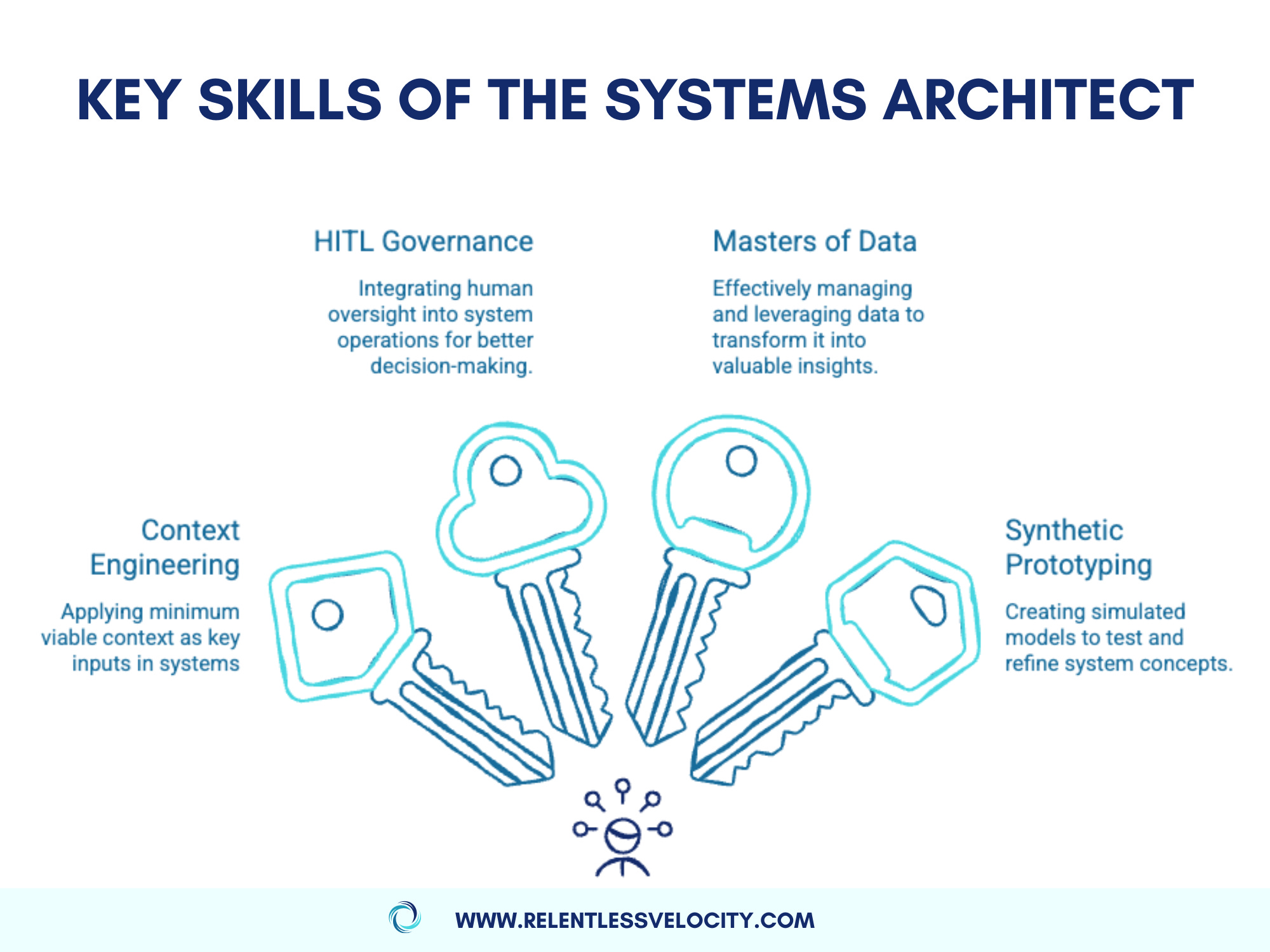
Context Engineering: Architects are obsessive about documenting the best way of doing things. Not only does this offer a clear line of sight into the steps, roles, and responsibilities, but it also allows for seamless onboarding. More importantly, it provides the necessary context for agents (who are insanely fast) to do the right work every time.
Remember, AI agents are strategically blind unless you provide what I call the Minimum Viable Context (MVC). The key value-add here is being the logic anchor. You ensure that the high-speed output of the machine is perfectly aligned with the company’s root logic (its strategy). Essentially, you leave the execution to the agents while you move your focus to the intent.
HITL Governance: Architects continue to manage the companies value chain. The difference moves to overseeing the Human-in-the-Loop (HITL) architecture versus manual processes and people. Architects design the specific logic gates where the AI Agents must pause for human judgment.
The value add here is one of governance, which should be somewhat familiar to you already, just in a different state. The ability to identify high-risk points where an agent might hit political friction or a nuance-heavy decision, and you install yourself (or someone with decision making authority) as the strategic filter. Ultimately becoming the manager of systems risk.
Masters of Data: Architects understand that project status is a legacy concept. To truly measure output, you need to measure against a set of relevant benchmarks in real-time. In an era where AI agents act as your analysts, the architect builds a system where the "Health" of an initiative is a live data stream.
Value is provided by moving away from historical reporting (what happened last week) to predictive governance (what’s about to break). Imagine the leverage a company gains when its systems flag logic leaks the moment they happen, versus a post-mortem a month later.
Synthetic Prototyping: The final skill in the Architect’s stack is the ability to stress-test ideas before they hit the real world. Instead of hoping for the best with a pilot, the architect deploys AI simulated personas to execute your plan.
The win here is the ability to find the fauilure points in a virtual environment in seconds. The architect is able to provide the company with pre-launch confidence that traditional operations functions simply cannot match. This is a real world example of being a fortune teller in your company.
Homework For You
Obtaining the skills to run this stack is probably months away for you versus weeks. This isn’t easy stuff to implement for yourself, not including the hurdles you have to navigate in your company.
What you can do immediately is the following.
Get Exceptional at the LLMs: Learn all about the models available from Chat GPT to Claude. Don’t be afraid to get their paid versions as well and experiment with the cutting edge and their true potential. I recommend every one do this.
Document Everything: Document with the mindset that the AI will be the ultimate audience. Detailed, step-by-step prompts provide context to humans now and AI Agents in the medium term.
Audit Your Handovers: Look at the ciritcal processes your a part of and identify one point where an output moves from your team to another as an input. Instead of a meeting to "hand it over," create a Shared Context API. a single source of truth (Notion, a shared doc, or a live dashboard) that is machine readable. Eliminate the middleman for that one specific seam. This in essence becomes your first MVC document you can use as a benchmark going forward.
I’m closing this article with the reminder that disruption most likely won’t be attacking the work, it’ll be coming for the logic behind it. With machine now with the ability to execute better than a human for most things, the only thing that matters is the architecture.
You can continue to be the bridge that information crawls across, or you can be the one who builds the high-speed rail.
The architect is the future of work.